skip to main |
skip to sidebar
A Panel Discussion: The Archive at the Whitechapel Gallery was chaired by Lisa Le Feuvre, an independent curator and writer. The discussions brought insights from Melanie Manchot, an artist who has worked with material from archives as instigation for her own work, from the gallery’s Archive Curator, Nayia Yiakoumaki, and from Marysia Lewandowska, an artist who is currently creating an online archive of recorded material from the 1980’s.For her project Celebration (Cyprus Street)  Melanie Manchot utilises the photographic archive at the Whitechapel Gallery for inspiration. She draws on traditions of group portraiture at public street parties, and her work explores individual and collective identity through photography and film.
  The film is shown alongside a new series of photographs made with the residents and a display of archive footage of street parties, such as peace parties in 1919 and 1945. Celebration (Cyprus Street) is part of the Gallery’s Education Programme, which commissions artists and explores the relationships between the Gallery, public spaces and community.
Mayysia Lewandowska spoke about her creation of  The Women’s Audio Archive which was established in 1985 when she moved from Warsaw to live and work in London. From an obsessive process of recording which marked the first engagement with cultural life in a new context and acted as a form navigational procedure performed for a personal use, she decided that the closed collection should be made publicly available. This involves negotiations with various authors securing the new terms of use open to all. The project consists of taped conversations with women involved in different aspects of cultural production as well as recordings public lectures and conferences between 1983-1990 in England, USA and Canada.
The archive is hosted at the Library and Archives of Center for Curatorial Studies Bard College contains over 50 hours of material featuring amongst others Susan Hiller, Judy Chicago, Mary Kelly and Donald Judd. The movement from Private to Public domain of this archive has not been without its problems and the thorny issue of copyright has proved a stumbling block on more than one occasion.
Diana Harrison's Box is a two part installation of quilts based on discarded cardboard boxes. The larger of the two (left) is wall hung and the edge panels are allowed (or possibly even encouraged) to curl as they would naturally do on a damp, discarded box.
The subtle colouring of the layers of dyed and bleached cloth is enhanced by the stitching lines that add to the sense of wear and tear that such a box would have seen. That the second piece is shown on the floor as if randomly strewn there is very apt. For me this is the most exciting piece in the exhibition.
Based on a box lid its similarity of shape to so many of the bed quilts on show is unmistakable. Again incredibly subtle in its colouration and stitch detail it is the rendering of the marks left by parcel tape that sets this piece apart as being so outstanding.
 Close inspection reveals the bands of sticky marks to be rendered as lines of immaculate tiny holes that allow the deeper, darker, layers to show through.
 I would highly recommend watching the video of Diana talking about the inspiration behind the making of the quilts on the V&A
Quilts 1700 - 2010, at the V&A explores over 300 years of British quilting. A stunning array of both traditional and contemporary quilts has been sympathetically displayed to showcase not only the exquisite workmanship involved but also the, often political, messages engendered within the work. For me the highlight was Diana Harrison's Box quilts (see next posting) Winter/Male (detail, left) and Summer/Female by Jo Budd are a response to the changing seasons in the Suffolk water meadows and surrounding landscape. The tall vertical forms of Winter/Male echo the more solid, blocky, elements of the landscape; trees, farmhouses and field boundaries. The darker, more earthy colours of this piece also speak of man's connection to the soil. By contrast Summer/Female is altogether softer in appearance, with curved forms and paler colours alluding to the gentler climate of summer days and rounded form of the female body. I may be a little cynical here but I am somehow not surprised that it is the Male version that has been purchased by the V&A.
 I was disappointed by the size of the screen on which Nicola Nasmith's Between Counting was displayed. Having seen, and heard, this on a much larger screen I felt that this exceptional piece was rather lost in a corner. The work centers on her exploration of the connection between the industrial and the hand made - it is the industrially made needle that enables the highly skilled hand piecing and quilting to be carried out.
 I thought that the walls of crushed cars flanking the entrance to this Birmingham car park showed a great sense of humour on the part of both the operators and users.
Curtain Show at Birmingham's Eastside Project showcases a wide ranging number of projects  from Albrect Schafers recreation of an aluminium curtain wall facade from Berlin to Grace Ndiritu's Still Life, set in an area curtained off with West African fabrics from Holland, fabricated in China, and available in Birmingham's rag market.
Ines Schaber has been working on archive based projects since 2005. In a series of case studies, texts, and artistic works she investigates and tests notions of the archive, in which not the collecting and sorting of things, but the work and production done around archives is central. For Curtain Show Schaber is exhibiting Diabolic Tenant (2007) created with Celine Condorelli and Alex Nikitas (sound by Tychonas Michailidis). The domesticated, curved, enclosure formed by the green silk curtain harbours a directional speaker that is in conversation with another speaker placed in front of the more formal, almost industrialised, vertical blinds. The two curtains' discussion embodies the different social and political spheres that they inhabit and offers insights into both their functional and social roles.Blind: We have many things in common. We organise the relationship between inside and outside.Silk: (dismissive) The old myth of inside and outside. Thereby I am a scheme for a space and you an attribute of it. In my case however, it is about structure - more than separating, it is about creating a new space.
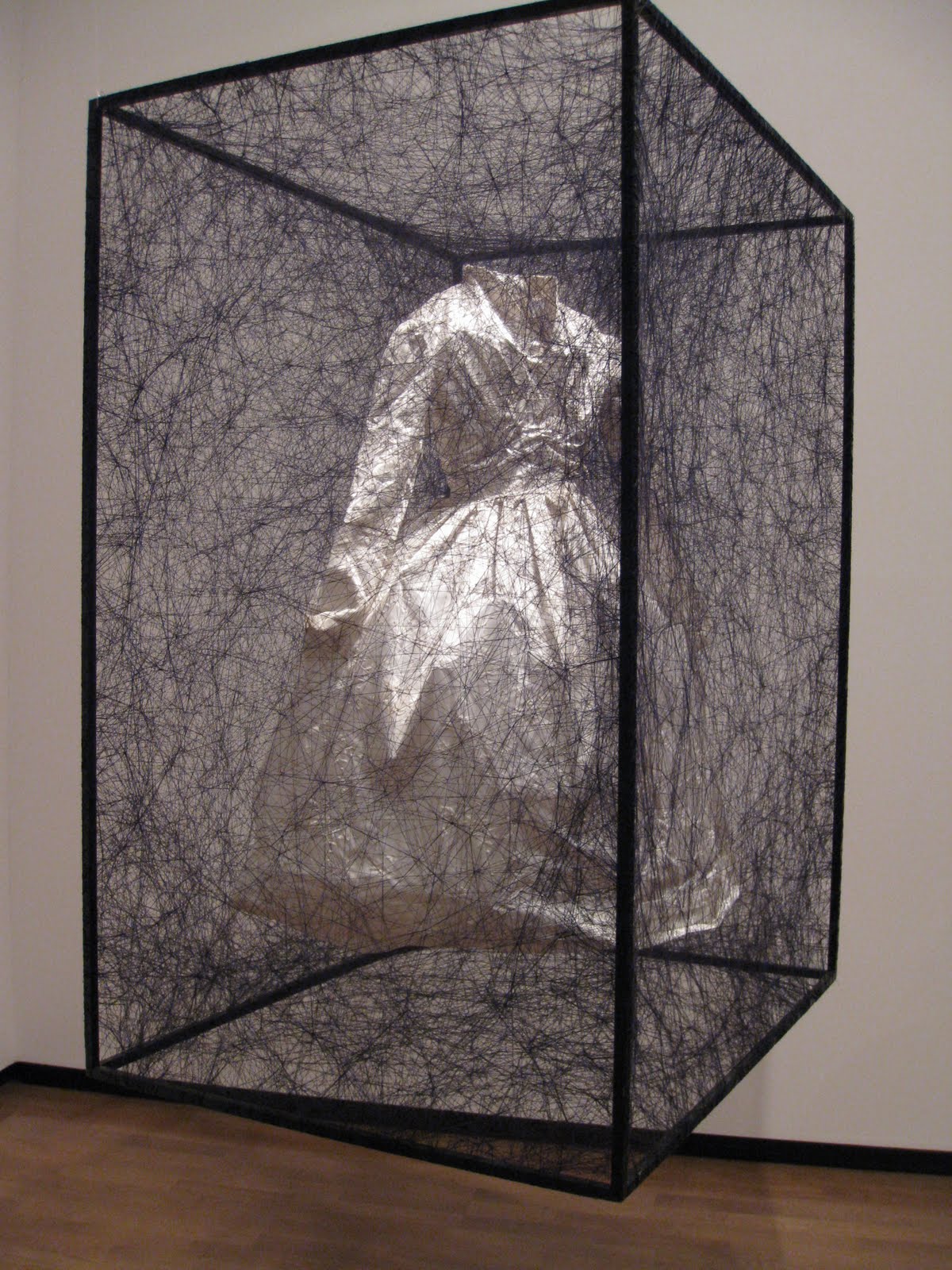
Chiharu Shiota's exhibition at Haunch of Venison moves on from One Place with another room filling installation - During Sleep and then on to a series of smaller pieces Trauma.
 During Sleep speaks hauntingly of that which goes on around us in the night when we sleep, the tunnel through which the audience walks could so easily close off behind them, leaving them no choice but to keep moving forward.
  The creeping cobwebs that engulf and trap the unwary are constantly searching for a new victim
 The innocent white bed and its crumpled sheets offer little protection from the encroaching mass of obliterating black webs
 As one looks closer the shadows of the webs become visible as if dreams, or nightmares, were becoming manifest and multiplying in the gloom.
 The final area of the exhibition, Trauma, is a series of smaller 'boxed' thread works that enclose everyday objects, such as dresses and hair brushes, in black webs. If the webs were white they might be seen as protecting the objects but here, in black, they trap and imprison forming an impenetrable barrier to those who might seek to free the objects.
 Constructed Space, at The Sunbury Embroidery Gallery, is an exhibition of work by four artist/makers who met whilst undertaking MA studies at UCA Farnham. They work in different materials but each is concerned not only with the construction of the work, but with the negative spaces that result, and how these spaces contrast with, accentuate and highlight the made objects. The 'spaces' allow light to permeate so the shadows become part of the architecture of the pieces.
 Gail Baxter uses hand made paper to reference the sedimentation process by which archives are formed. The dramatic impact of her installation of paper lace cubes comes not from the delicate white tracery of the lace itself but from the effective use of lighting to draw new patterns on the walls. The angled lighting highlighting the different impression that is obtained according to one's point of view.
 Carol Quarini's work examines the familiar becoming strange and the slippage between the animate and inanimate and the familiar turning on its owner. Her delicate net curtains reveal a subtly more menacing side when one takes the time to look closely at what the curtains are saying. Taking on a voice of their own and engaging in whispered conversations these apparently innocent nets know a secret or two. . . 'Appearances can be deceptive'
 Ros Perton uses porcelain and other coarser clays to exploit the distinctive textual relationships between materials for visual and tactile effects. Here she shows a range of ceramics from translucent porcelain orchid pots to stacked vessels that showcase a variety of ceramic materials.
 Tracy Nicholls completes the lineup with her fused and slumped glass panels. Visually these remarkable pieces are very strong and yet the knowledge that they are made of glass constantly reminds the viewer that they are also very fragile.